Buyer guide
How to choose a GPS tracker in 2026
A practical, vendor-neutral checklist for choosing a tracker by asset, power source, coverage, reporting needs, privacy and total cost.
Updated · 9 min read · Runic
Short answer
Start with the job, not the device. A tag can be enough for keys or luggage; a vehicle that needs remote movement alerts needs GNSS positioning, mobile connectivity and a platform. Then compare installation, power, coverage, reporting interval, history, data controls and total cost over the period you expect to use it.
Key takeaways
- Choose the tracking method for the asset and the consequence of losing it.
- GPS or another GNSS calculates a position; connectivity carries that position to your map.
- Compare coverage, installation, useful platform features and total cost—not only the device price.
1. Start with the job to be done
For keys, a suitcase or something misplaced occasionally, a Bluetooth or Find My network tag may be sufficient. It is inexpensive, compact and designed to be found through nearby devices. It is not an independent live vehicle-tracking system.
For a car, van, boat or machine, ask what you need when nobody else is nearby: live position, movement or power-cut alerts, journey history, or simply a stored route you retrieve later. The answer determines whether you need a connected GPS tracker or only a tag or logger.
2. Separate positioning from connectivity
A GNSS receiver estimates its position from satellite signals. That calculation does not put a dot on your phone by itself. For remote viewing, a tracker must also transmit the position—normally over a cellular network—to a service that stores and displays it.
This is why a live tracker has more moving parts than a Bluetooth tag: receiver, modem, connectivity, software and storage. Ask a seller what happens outside coverage and whether positions are buffered and uploaded later.
3. Match power and installation to the asset
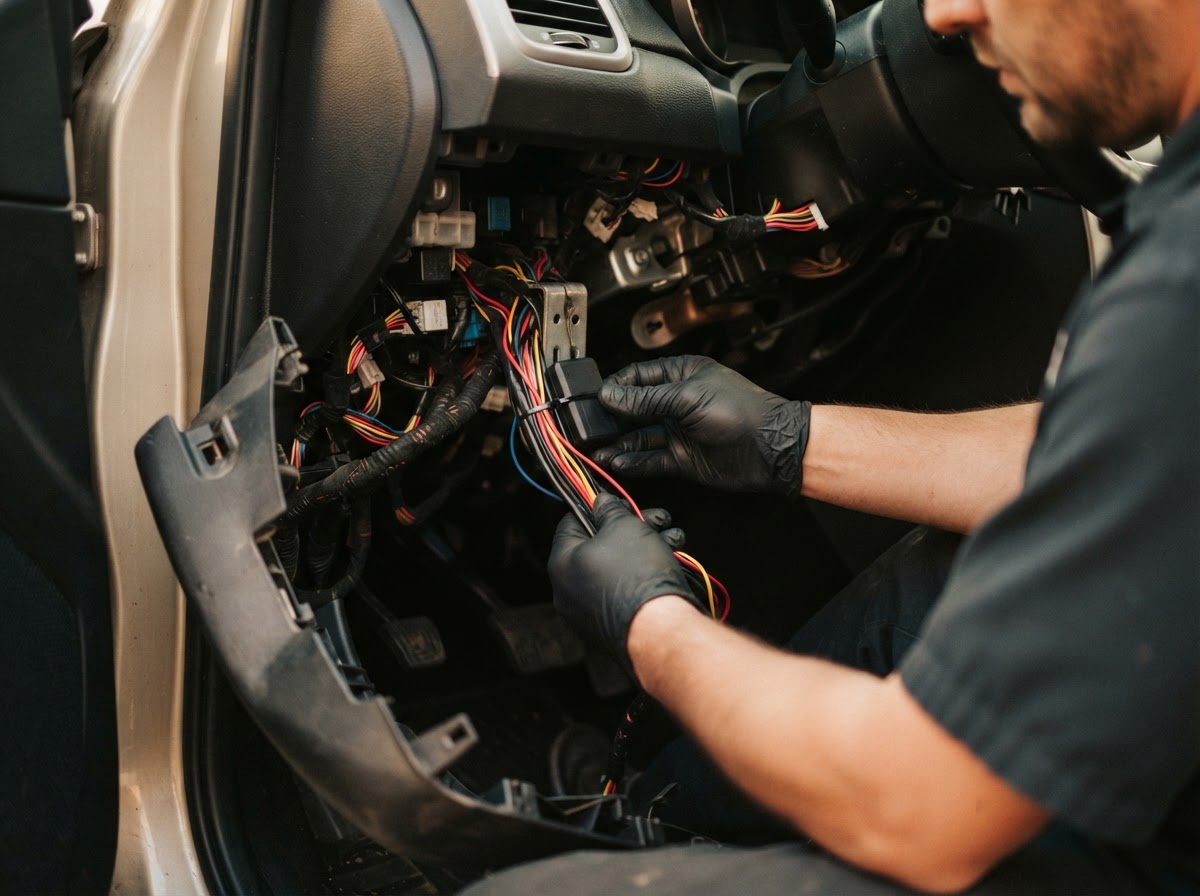
An OBD plug-in unit is quick to move between vehicles but visible and easy to remove. A hardwired unit is discreet and can read ignition, but should be fitted properly. A battery tracker suits trailers or equipment without permanent power, with reporting frequency and temperature affecting battery life.
Do not accept a battery-life number without the test conditions. Ask for the assumed update interval, network conditions and temperature, and whether movement changes the reporting rate.
4. Check network coverage and reporting behaviour
Coverage matters where the asset actually travels, including roaming. Connected-vehicle guidance from GSMA notes that mobile connectivity must support handover as a vehicle moves between cells. Ask which radio technology and regions the device supports, and what its migration plan is when networks change.
A ten-second update is not automatically better than a one-minute update: it consumes more data and power. Choose a cadence that fits the decision you need to make, and confirm how the device behaves when parked or offline.
5. Evaluate the platform, privacy and total cost
The useful product is the complete service, not the receiver alone. Test the map on a phone, alerts, journey history, exports, user roles and support. Ask how long data is retained, who can access it and how to delete it.
Add device, installation, connectivity, platform, replacement batteries and support over two or three years. A cheap device can cost more if its app disappears, roaming is extra or data must be assembled manually.
- Can I see a recent location and a useful history?
- Are movement, geofence and power alerts configurable?
- Who owns the data, who can access it, and how long is it retained?
- What is included across every country where the asset will travel?
- What happens if the network, app or service is discontinued?
A short pre-purchase test
Write down one asset, three alerts or reports you will actually use, the countries it visits and the maximum acceptable gap between updates. Ask each supplier to demonstrate those exact scenarios and state the complete multi-year price in writing. That comparison is more reliable than feature counts.
Frequently asked questions
- Is an AirTag enough for a car?
- It can help locate a personal item through Apple’s Find My network, but it is not an independent live vehicle tracker. For remote movement alerts and continuous journey history, use a connected GPS tracker designed for the asset.
- Does better GPS accuracy mean better tracking?
- Not by itself. Satellite visibility, antenna placement, receiver quality, reporting interval, connectivity and platform behaviour all affect the result you see.
- Should I choose 4G, LTE-M or NB-IoT?
- Choose verified coverage and support for your routes and use case, not a label alone. Ask the supplier which networks the exact model uses, where roaming is included and what happens if a preferred network is unavailable.